 Cặm bẫy bạo ngược và nô lệ trong chế độ tân phong kiến tập quyền, hay đế quốc phát xít được gói kín trong mô hình CỘNG HÒA DÂN CHỦ GIÁN TIẾP (dân chủ đại diện) được giấu kín gần hai trăm năm. Và sau khi cuộc chiến tranh lạnh giữa mô hình độc tài tư bản dứoi danh nghĩa "chủ nghĩa Cộng Sản" và mô hình dân chủ gián tiếp xã hội mang danh nghĩa "tư bản" chấm dứt vào đầu thập niên 1990s, nó, mô hình "dân chủ gián tiếp hay đại diện " được mệnh danh sai lầm là "tư bản tự do" đã dơ đủ nanh vuốt của một hệ thống tập đoàn phát xít đại bản và đế quốc, dẫn đầu là nước Mỹ trong mục tiêu tái lập mô hình phong kiến đại bản tập quyền.
Nước Mỹ không còn chỉ là đang thoái hóa, mà hẳn nhiên công khai lộ rõ bản chất của bạo ngược phi dân chủ đế quốc. Sự thể hiện không chỉ qua chính sách đế quốc toàn cầu mà ngay trong chính nội tại của nó. Sau chiến tranh lạnh, Mỹ trở thành quốc gia mạnh nhất về mọi lãnh vực. Nó chiếm giữ đại đa số tài nguyên bằng bạo lực quân sự và chính trị với hơn 1000 căn cứ quân sự toàn cầu bằng một lực lượng quân đội khổng lồ vói ngân sách so ra bao trùm toàn bộ các quốc gia khác . Và trên hết nó khống trị nền tài chính thế giới gần như toàn diện về mọi khía cạnh với nền độc trị của Mỹ Kim và quyền in phát vô hạn định.
Đây không phải là lời cáo buộc xuông cảm tính vô căn cứ, mà chính là diễn biến cụ thể đang xảy ra từng ngày trên thế giới. Không kể cấu trúc hệ thống tài chính đều qui về Newyork và London gián tiếp qua Ngân Hàng Dự Trữ Liên Bang Mỹ (với một định chế ẩn tàng lấp ló sau lưng đặt tại Thụy Sĩ Bank for International Settlements của tập đoàn "thượng phụ" Bilderberg chỉ đạo, mà trang Nhân Chủ đã có bàn qua), chúng ta cứ nhìn vào "chiếu chỉ" của Mỹ cho các quốc gia khác không được quan hệ buôn bán với Viêt Nam sau 1975 và mới đây "chiếu chỉ" của Mỹ cho các quốc gia không được mua dầu hỏa hay trao đổi với Iran và Syria thì đã rõ CHỨC NĂNG và THẦM QUYỀN TỰ PHONG của một đế quốc!
Không dừng lại ở những tên chư hầu cấp lớn, chính giới Mỹ còn ngang ngược một cách nhỏ nhen đe dọa bóp chết nền kinh tế của đảo quốc nhỏ xíu Tavalu ở Thái Bình Dương vì đảo quốc này dám cưỡng lệnh trao đổi với Iran. Dĩ nhiên nó cũng không xấu hổ ngượng ngùng gì, Mỹ và các chư hầu còn vô liêm sỉ bất chấp cái gọi là Công Pháp Quốc Tế tiến chiếm bằng quân sự các quốc gia chủ quyền khác, mà ngay cả những nguyên tắc căn bản ngoại giao, pháp luật quốc tế, Mỹ và chư hầu cũng ngang nhiên gạt bỏ như vụ truy bắt nhà báo dân sự sáng lập Wikileaks Julian Assange. Trong khi Mỹ và Tây phương ép Trung Quốc hành xử theo công ước ngoại giao đối với nhà "đối kháng Mù" Trần Quang Thành khi ông này xin tị nạn chính trị tại tòa đại sứ Mỹ tại Bắc Kinh, thì Mỹ và Anh, Thụy Điển đang chà đạp ngay nguyên tắc này khi Assange xin tị nạn tại tòa đại sứ Ecuador. Ngược lại Mỹ man rợ phi nhân quyền khi đối xử với chính công dân của nó là anh Bradley Manning, ngừoi đã tố cáo tội phạm và tội ác của quân đội Mỹ và nhà nước Mỹ, một hành động mà Mỹ bô bô khuyến khích tại những nơi chưa qui phục nền đế quốc Mỹ, nhưng lại đồng thuận áp chế nếu hành xử này được thể hiện tại những nước chư hầu đã vào vòng đế quốc của Mỹ như Arab Seoud, Kuwait v.v và ngay tại chính quốc Mỹ như chúng ta đang thấy trước mắt.
Mỹ hiện nay ngang nhiên "ra chiếu chỉỉ chỉ định" cho quốc gia nào phải làm gì! Nếu không, nó dập nát như Iraq, Afganistan, Lybia và hiện nay đang tung tiền, tung vũ khí và quân gián điệp vào Syria để dập nát xứ sở này.
Nó mang tính đế quốc tế vi hơn bất kỳ đế quốc nào trong lịch sử, vì nó sử dụng nhuần nhuyễn chiêu bài DÂN CHỦ DÂN QUYỀN với kịch bản QUỐC HỘI LƯỠNG VIỆN và LƯỠNG ĐẢNG, thật sự chỉ là một , mà không một đế quốc nào từng biết đến để tận dụng diễn trò! Mỹ lên án các nước độc tài là ngăn chặn tự do thông tin, quyền biểu tình đối kháng. Nhưng chính nó đàn áp biều tình đối kháng triệt để và man rợ hơn bất cứ ai, man rợ một cách "hợp pháp" và bất chấp hiến pháp của chính nó bằng chính những sắc luật của hành pháp và đạo luật của quốc hội vi hiến.
Nển pháp trị đã biến thành pháp quyền, và nhà nước đán áp ức chế xã hội trắng trợn "hợp pháp", như vừa đây Obama đã ký sắc lệnh kềm tỏa kiểm soát toàn bộ thông tin quốc gia, trực tiếp xâm phạm quyền riêng tư của từng ngừoi dân (xem phụ chú). Nền chính trị pháp quyền của Mỹ bạo ngược hơn cả Trung Cộng hay Việt Nam về mặt đanh thép và chi tiết, vì Mỹ vừa cao cấp hơn về kỹ thuật lực lượng vừa được hổ trợ bởi một lực lượng đại bản lớn nhất thế giới- Và nó không chỉ gạt bỏ Hiến Pháp, Mỹ ngày nay cấu trúc chính trị và hoạt động cính trị ngược hẳn với tinh thần bản Tuyên Ngôn sự ra đòi của chính nó, triệt hạ tinh thần đối kháng của quần chúng đến mức thấp nhất qua màn kịch dân chủ lưỡng đảng-và cung cách lạm dụng ý niệm dân chủ gián tiếp trong quyền lực hành pháp. Thực chất hai đảng chỉ là MỘT. Bọn chính trị gia đều ăn lương của tập đoàn đại bản và tài chính, trừ một vài cá nhân biệt lệ hiếm hoi như Ron Paul hay Kuchinic đã bị loại.
 Hiên nay,nhà nước Mỹ ngang nhiên trăng trợn vi phạm nguyên tắc dân quyền và nguyên lý nhân quyền, gạt bỏ Hiến pháp, điền hình: bất cứ những ai, nhóm nào lập hội lập quĩ để bênh vực pháp lý và tinh thần cho anh lính Bradley Manning đều bị FBI theo dõi và sách nhiễu cũng như tạo cớ bắt giữ và ghép tội danh "làm lợi cho khủng bố" hoặc "đe dọa an ninh quốc gia".
Tiến trình "toàn cầu" này, dĩ nhiên không chỉ dừng lại ở Mỹ. Nó là đế quốc, nó "chiếu chỉ" cho các chư hầu thực hiện từng bước, tùy vào mức dân trí đối kháng của mỗi quốc gia đó. Những quốc gia như Anh Úc Âu Châu đang cố gắng thi hành chiếu chỉ một cách chậm hơn, từng bước tháo gỡ những dân quyền và nhân quyền mà quần chúng , công đoàn công nhân đã đạt được hơn nửa thế kỷ qua từ sau Thế Chiến thứ Hai. Chúng ta đang chứng kiến nó xảy ra khắp Âu Châu: Nhà nước tước đoạt dầndần dân quyền và nhân quyền nhân danh an- ninh và trật tự xã hội, sau những "biến cố khủng bố" và khủng hoảng kinh tế tài chính do chính bọn nhà nước và tập đoàn đại bản cấu kết tạo ra.
Một "hiện tượng" chỉ xảy ra ở thế kỷ 21 này, là tất cả những chế độ độc tài nào qui thuận luật chơi của Mỹ Tây Phương đều đươc 'TẠM THỜI DUNG TÚNG" còn bất cứ chế độ nào, từ dân chủ tự do đến độc tài, thực chết hay biểu kiến v.v mà CHƯA THUẦN PHỤC MỸ, đều đang bị nó tấn công, cô lập và phá hoại để lật đổ.
Nhưng đó vẫn chỉ là con đường mà Mỹ và đám quyền bính Bilderberg cho rằng khả thi và vô địch, vì nó đang uu thắng. Nhưng sự kiện con cưng Ai Cập Mubarak bất ngờ bị lật đổ bởi một quần chúng dân trí chưa cao nhưng được vận động đúng mức, mà Mỹ và tay sai không thể cưỡng lại, cũng như cao trào Chiếm Phố Wall, và phong trào tự tạo bản vị tiền tệ địa phương tại Đức trong nỗ lực tháo gỡ xiềng xích tài chính, đã cho thấy MƯU SỰ TẠI MÀY THÀNH SỰ TẠI TAO của qui lật vận động dân trí và quyền lực của quần chúng.
Nhân loại nói chung và những cao trào đối kháng nói riêng, chỉ thành công trong công cuộc chống độc tài bạo ngược xây dựng nền tự do, khi nào họ xác định được nhu cầu đặt nền tảng cho một nền DÂN CHỦ TRỰC TIẾP đích thật, rõ ràng minh định hơn cả mô thức còn thiếu khuyết của Thụy Sĩ. Chỉ khi đó, quyền lực nguòi dân trực tiếp chỉ đạo xã hội, các định chế chỉ là phương tiện điều hành, thì những năng lực sinh mạng hiện nay đang phải hao phí vào các cuộc biều tình đối kháng sẽ không còn cần thiết nữa. Những lạm dụng của giới quyềnm bính đã bị suy giảm hoặc được ngan chặn từ ngay nguyên lý và nguyên tắc TRƯNG CẦU DÂN Ý bất kỳ một đạo luật nào của xã hội hay bất kỳ phán quyết nào của quốc gia.
Nhân Chủ
12-7-2012
---------------------
Nguồn Tham Khảo Thêm:
Obama Seizes Control of All Communications Systems With Executive Order
By Susanne Posel
Global Research, July 9, 2012
President Obama has usurped all available forms of communication for use and discretion of the US government. Under an Executive Order (June 6, 2012) entitled Assignment of National Security and Emergency Preparedness Communications Functions, Obama has enabled the executive branch to control communications “under all circumstances to ensure national security, effectively manage emergencies, and improve national resilience.” (For full text of the Executive Order, seen Annex below).
Radio and wired communications systems “of all levels of government, the private and nonprofit sectors, and the public must inform the development of national security and emergency preparedness (NS/EP) communications policies, programs, and capabilities.”
Cellular phone corporations like Sprint owned Boost Mobile have released messages to their customers concerning the US government’s allocation of their phone communications at the whim of the President. In a text message to customers, Boost Mobile said that: “. . . you can receive national and local emergency alerts directly on your phone.”
Back in 2011, Hillary Clinton admitted that the US government, via the mainstream media, is losing their “information war” with the American public. As alternative media becomes more prevalent, the propaganda must be taken up a notch in order to keep the masses onboard with the agendas of the US government.
Danny Schechter, filmmaker and investigative journalist, explains that MSM cannot compete with the alternative media. Schechter says that “America feels on the defensive because it can no longer” monopolize the thoughts of citizens domestically and abroad. Since the US government thinks “its point of view is the only point of view” these new news outlets are “extremely damaging” to the US continual purveyance of propaganda.
The Presidential Alert was announced in August of 2011, wherein the Commissioners for the FCC required that television, radio stations and cable systems (including satellites) will redirect broadcasting if the President wants to “alert Americans of impending danger”.
This EO explains that the establishment of a NS/EP Communications Executive Committee (CEC) will “serve as a forum to address NS/EP communications matters”. The CEC will answer to the director of the Office of Science and Technology Policy (OSTP) and advise Obama on the “prioritization of radio spectrum and wired communications that support NS/EP functions”.
Designees of DHS and Department of Defense will be co-Chairs of the CEC. While the CEC will now advise on policy to Obama; they will have control over the “future architecture of the NS/EP communications” and define those communications in a “long-term strategic vision”.
The funding for this all-encompassing control over our radio, television and digital communications will be taken from the taxpayers by way of the Office of Management and Budget (OMB).
Under Obama’s discretion, all radio and digital communications can be intercepted with recommendation by the assistant to the President for Homeland Security and Counterterrorism and the Director of OSTP. The executive branch’s authority derives from the Communications Act of 1934, as amended (47 U.S.C. 606), Section 706.
The US governmental agencies involved in this endeavor are the heads of:
• Department of Justice
• Department of Defense
• Department of State
• Department of Commerce
• Department of Homeland Security (DHS)
• Office of the director of National Intelligence (DNI)
• General Services Administration
• Federal Communications Commission (FCC)
• Department of Defense
• Department of State
• Department of Commerce
• Department of Homeland Security (DHS)
• Office of the director of National Intelligence (DNI)
• General Services Administration
• Federal Communications Commission (FCC)
The President enables the “regimes to test, exercise, and evaluate the capabilities of existing and planned communications systems, networks, or facilities” and provides “quarterly updates to the Assistant to the President for Homeland Security and Counterterrorism and the Director of OSTP”.
The Secretary of Homeland Security (SHS) will create an Executive Committee Joint Program Office (JPO) that has been tasked with “coordination of programs that support NS/EP missions, priorities, goals, and policy. The JPO and the CEC will meet with governmental and non-governmental organizations (NGOs) to decide on “development of policies”.
The SHS also has the responsibility of facilitating communications in the event and support of Continuity of Government on the federal, state, local, territorial, and tribal levels. In an emergency the SHS will alert “non-military executive branch communications systems; critical infrastructure protection networks; and non-military communications networks, particularly with respect to prioritization and restoration”.
The Secretary of Defense will develop, implement and sustain NS/EP communications in response to national security needs as directed by “the President, Vice President, and senior national leadership, including: communications with or among the President, Vice President, White House staff, heads of state and government, and Nuclear Command and Control leadership; Continuity of Government communications; and communications among the executive, judicial, and legislative branches to support Enduring Constitutional Government”.
In conjunction with EO 12333, established by former President Ronald Reagan; wherein the powers of all US intelligence agencies were extended and all heads of federal agencies were admonished to comply with information requests from the Central Intelligence Agency (CIA), this new EO further empowers that already established fact.
All communications avenues must allow for the receipt, integration and dissemination of NS/EP communicational information that is supplied by the US government for the intention of American citizens. Whether private or publicly owned, those communications resources can and will be usurped by the President and/or governmental agencies.
“Relevant supporting entities” like the Government Emergency Telecommunications Service, Wireless Priority Service, Telecommunications Service Priority program, Next Generation Network Priority program will provide organization and management structure with the CEC, SHS and the President.
In the event of an “emergency” the Secretary of Commerce will allow for the takeover of radio frequencies as well as television and digital communications with the use of electromagnetics. These communicative abilities are now “belonging to and operated by the Federal Government” as resources to be utilized “during a crisis or emergency”.
The Administrator of General Services will purchase all necessary equipment to provide the US government capabilities to take over communications.
If the CIA or DNI deem it so, they are enabled to influence policy directives, procedures and guide issues that are relevant to the securing of national security.
The FCC’s role in this is to acquiesce “all entities licensed or regulated” by the FCC to ensure that messages are received and disseminated to the American public.
This latest EO is but one in a long string of presidential shows of authority that lays the foundation for the establishment of a dictatorship in America.
ANNEX
[White House. June 6, 2012]
Executive Order -- Assignment of National Security and Emergency Preparedness Communications Functions
EXECUTIVE ORDER
ASSIGNMENT OF NATIONAL SECURITY AND
EMERGENCY PREPAREDNESS COMMUNICATIONS FUNCTIONS
By the authority vested in me as President by the Constitution and the laws of the United States of America, it is hereby ordered as follows:EMERGENCY PREPAREDNESS COMMUNICATIONS FUNCTIONS
Section 1. Policy. The Federal Government must have the ability to communicate at all times and under all circumstances to carry out its most critical and time sensitive missions. Survivable, resilient, enduring, and effective communications, both domestic and international, are essential to enable the executive branch to communicate within itself and with: the legislative and judicial branches; State, local, territorial, and tribal governments; private sector entities; and the public, allies, and other nations. Such communications must be possible under all circumstances to ensure national security, effectively manage emergencies, and improve national resilience. The views of all levels of government, the private and nonprofit sectors, and the public must inform the development of national security and emergency preparedness (NS/EP) communications policies, programs, and capabilities.
Sec. 2. Executive Office Responsibilities.
Sec. 2.1. Policy coordination, guidance, dispute resolution, and periodic in-progress reviews for the functions described and assigned herein shall be provided through the interagency process established in Presidential Policy Directive-1 of February 13, 2009 (Organization of the National Security Council System) (PPD-1).
Sec. 2.2. The Director of the Office of Science and Technology Policy (OSTP) shall: (a) issue an annual memorandum to the NS/EP Communications Executive Committee (established in section 3 of this order) highlighting national priorities for Executive Committee analyses, studies, research, and development regarding NS/EP communications;
(b) advise the President on the prioritization of radio spectrum and wired communications that support NS/EP functions; and
(c) have access to all appropriate information related to the test, exercise, evaluation, and readiness of the capabilities of all existing and planned NS/EP communications systems, networks, and facilities to meet all executive branch NS/EP requirements.
Sec. 2.3. The Assistant to the President for Homeland Security and Counterterrorism and the Director of OSTP shall make recommendations to the President, informed by the interagency policy process established in PPD-1, with respect to the exercise of authorities assigned to the President under section 706 of the Communications Act of 1934, as amended (47 U.S.C. 606). The Assistant to the President for Homeland Security and Counterterrorism and the Director of OSTP shall also jointly monitor the exercise of these authorities, in the event of any delegation, through the process established in PPD-1 or as the President otherwise may direct.
Sec. 3. The NS/EP Communications Executive Committee.
Sec. 3.1. There is established an NS/EP Communications Executive Committee (Executive Committee) to serve as a forum to address NS/EP communications matters.
Sec. 3.2. The Executive Committee shall be composed of Assistant Secretary-level or equivalent representatives designated by the heads of the Departments of State, Defense, Justice, Commerce, and Homeland Security, the Office of the Director of National Intelligence (DNI), the General Services Administration, and the Federal Communications Commission, as well as such additional agencies as the Executive Committee may designate. The designees of the Secretary of Homeland Security and the Secretary of Defense shall serve as Co-Chairs of the Executive Committee.
Sec. 3.3. The responsibilities of the Executive Committee shall be to: (a) advise and make policy recommendations to the President, through the PPD-1 process, on enhancing the survivability, resilience, and future architecture of NS/EP communications, including what should constitute NS/EP communications requirements;
(b) develop a long-term strategic vision for NS/EP communications and propose funding requirements and plans to the President and the Director of the Office of Management and Budget (OMB), through the PPD-1 process, for NS/EP communications initiatives that benefit multiple agencies or other Federal entities;
(c) coordinate the planning for, and provision of, NS/EP communications for the Federal Government under all hazards;
(d) promote the incorporation of the optimal combination of hardness, redundancy, mobility, connectivity, interoperability, restorability, and security to obtain, to the maximum extent practicable, the survivability of NS/EP communications under all circumstances;
(e) recommend to the President, through the PPD-1 process, the regimes to test, exercise, and evaluate the capabilities of existing and planned communications systems, networks, or facilities to meet all executive branch NS/EP communications requirements, including any recommended remedial actions;
(f) provide quarterly updates to the Assistant to the President for Homeland Security and Counterterrorism and the Director of OSTP, through the Co-Chairs, on the status of Executive Committee activities and develop an annual NS/EP communications strategic agenda utilizing the PPD-1 process;
(g) enable industry input with respect to the responsibilities established in this section; and
(h) develop, approve, and maintain a charter for the Executive Committee.
Sec. 4. Executive Committee Joint Program Office.
Sec. 4.1. The Secretary of Homeland Security shall establish an Executive Committee Joint Program Office (JPO) to provide full-time, expert, and administrative support for the Executive Committee's performance of its responsibilities under section 3.3 of this order. Staff of the JPO shall include detailees, as needed and appropriate, from agencies represented on the Executive Committee. The Department of Homeland Security shall provide resources to support the JPO. The JPO shall be responsive to the guidance of the Executive Committee.
Sec. 4.2. The responsibilities of the JPO shall include: coordination of programs that support NS/EP missions, priorities, goals, and policy; and, when directed by the Executive Committee, the convening of governmental and nongovernmental groups (consistent with the Federal Advisory Committees Act, as amended (5 U.S.C. App.)), coordination of activities, and development of policies for senior official review and approval.
Sec. 5. Specific Department and Agency Responsibilities.
Sec. 5.1. The Secretary of Defense shall: (a) oversee the development, testing, implementation, and sustainment of NS/EP communications that are directly responsive to the national security needs of the President, Vice President, and senior national leadership, including: communications with or among the President, Vice President, White House staff, heads of state and government, and Nuclear Command and Control leadership; Continuity of Government communications; and communications among the executive, judicial, and legislative branches to support Enduring Constitutional Government;
(b) incorporate, integrate, and ensure interoperability and the optimal combination of hardness, redundancy, mobility, connectivity, interoperability, restorability, and security to obtain, to the maximum extent practicable, the survivability of NS/EP communications defined in section 5.1(a) of this order under all circumstances, including conditions of crisis or emergency;
(c) provide to the Executive Committee the technical support necessary to develop and maintain plans adequate to provide for the security and protection of NS/EP communications; and
(d) provide, operate, and maintain communication services and facilities adequate to execute responsibilities consistent with Executive Order 12333 of December 4, 1981, as amended.
Sec. 5.2. The Secretary of Homeland Security shall: (a) oversee the development, testing, implementation, and sustainment of NS/EP communications, including: communications that support Continuity of Government; Federal, State, local, territorial, and tribal emergency preparedness and response communications; non-military executive branch communications systems; critical infrastructure protection networks; and non-military communications networks, particularly with respect to prioritization and restoration;
(b) incorporate, integrate, and ensure interoperability and the necessary combination of hardness, redundancy, mobility, connectivity, interoperability, restorability, and security to obtain, to the maximum extent practicable, the survivability of NS/EP communications defined in section 5.2(a) of this order under all circumstances, including conditions of crisis or emergency;
(c) provide to the Executive Committee the technical support necessary to develop and maintain plans adequate to provide for the security and protection of NS/EP communications;
(d) receive, integrate, and disseminate NS/EP communications information to the Federal Government and State, local, territorial, and tribal governments, as appropriate, to establish situational awareness, priority setting recommendations, and a common operating picture for NS/EP communications information;
(e) satisfy priority communications requirements through the use of commercial, Government, and privately owned communications resources, when appropriate;
(f) maintain a joint industry-Government center that is capable of assisting in the initiation, coordination, restoration, and reconstitution of NS/EP communications services or facilities under all conditions of emerging threats, crisis, or emergency;
(g) serve as the Federal lead for the prioritized restoration of communications infrastructure and coordinate the prioritization and restoration of communications, including resolution of any conflicts in or among priorities, in coordination with the Secretary of Defense when activities referenced in section 5.1(a) of this order are impacted, consistent with the National Response Framework. If conflicts in or among priorities cannot be resolved between the Departments of Defense and Homeland Security, they shall be referred for resolution in accordance with section 2.1 of this order; and
(h) within 60 days of the date of this order, in consultation with the Executive Committee where appropriate, develop and submit to the President, through the Assistant to the President for Homeland Security and Counterterrorism, a detailed plan that describes the Department of Homeland
Security's organization and management structure for its NS/EP communications functions, including the Government Emergency Telecommunications Service, Wireless Priority Service, Telecommunications Service Priority program, Next Generation Network Priority program, the Executive Committee JPO, and relevant supporting entities.
Sec. 5.3. The Secretary of Commerce shall: (a) provide advice and guidance to the Executive Committee on the use of technical standards and metrics to support execution of NS/EP communications;
(b) identify for the Executive Committee requirements for additional technical standards and metrics to enhance NS/EP communications;
(c) engage with relevant standards development organizations to develop appropriate technical standards and metrics to enhance NS/EP communications;
(d) develop plans and procedures concerning radio spectrum allocations, assignments, and priorities for use by agencies and executive offices;
(e) develop, maintain, and publish policies, plans, and procedures for the management and use of radio frequency assignments, including the authority to amend, modify, or revoke such assignments, in those parts of the electromagnetic spectrum assigned to the Federal Government; and
(f) administer a system of radio spectrum priorities for those spectrum-dependent telecommunications resources belonging to and operated by the Federal Government and certify or approve such radio spectrum priorities, including the resolution of conflicts in or among such radio spectrum priorities during a crisis or emergency.
Sec. 5.4. The Administrator of General Services shall provide and maintain a common Federal acquisition approach that allows for the efficient centralized purchasing of equipment and services that meet NS/EP communications requirements. Nothing in this section shall be construed to impair or otherwise affect the procurement authorities granted by law to an agency or the head thereof.
Sec. 5.5. With respect to the Intelligence Community, the DNI, after consultation with the heads of affected agencies, may issue such policy directives and guidance as the DNI deems necessary to implement this order. Procedures or other guidance issued by the heads of elements of the Intelligence Community shall be in accordance with such policy directives or guidelines issued by the DNI.
Sec. 5.6. The Federal Communications Commission performs such functions as are required by law, including: (a) with respect to all entities licensed or regulated by the Federal Communications Commission: the extension, discontinuance, or reduction of common carrier facilities or services; the control of common carrier rates, charges, practices, and classifications; the construction, authorization, activation, deactivation, or closing of radio stations, services, and facilities; the assignment of radio frequencies to Federal Communications Commission licensees; the investigation of violations of pertinent law; and the assessment of communications service provider emergency needs and resources; and
(b) supporting the continuous operation and restoration of critical communications systems and services by assisting the Secretary of Homeland Security with infrastructure damage assessment and restoration, and by providing the Secretary of Homeland Security with information collected by the Federal Communications Commission on communications infrastructure, service outages, and restoration, as appropriate.
Sec. 6. General Agency Responsibilities. All agencies, to the extent consistent with law, shall: (a) determine the scope of their NS/EP communications requirements, and provide information regarding such requirements to the Executive Committee;
(b) prepare policies, plans, and procedures concerning communications facilities, services, or equipment under their management or operational control to maximize their capability to respond to the NS/EP needs of the Federal Government;
(c) propose initiatives, where possible, that may benefit multiple agencies or other Federal entities;
(d) administer programs that support broad NS/EP communications goals and policies;
(e) submit reports annually, or as otherwise requested, to the Executive Committee, regarding agency NS/EP communications activities;
(f) devise internal acquisition strategies in support of the centralized acquisition approach provided by the General Services Administration pursuant to section 5.4 of this order; and
(g) provide the Secretary of Homeland Security with timely reporting on NS/EP communications status to inform the common operating picture required under 6 U.S.C. 321(d).
Sec. 7. General Provisions. (a) For the purposes of this order, the word "agency" shall have the meaning set forth in section 6.1(b) of Executive Order 13526 of December 29, 2009.
(b) Executive Order 12472 of April 3, 1984, as amended, is hereby revoked.
(c) Executive Order 12382 of September 13, 1982, as amended, is further amended by striking the following language from section 2(e): "in his capacity as Executive Agent for the National Communications System".
(d) Nothing in this order shall be construed to impair or otherwise affect:
(i) the authority granted by law to an agency, or the head thereof; or
(ii) the functions of the Director of the OMB relating to budgetary, administrative, or legislative proposals.
(e) This order shall be implemented consistent with applicable law and subject to the availability of appropriations.
(f) This order is not intended to, and does not, create any right or benefit, substantive or procedural, enforceable at law or in equity by any party against the United States, its departments, agencies, or entities, its officers, employees, or agents, or any other person.
BARACK OBAMA
-------------------------------------------------------------------
Hands Off Tuvalu!
Posted By Justin Raimondo On July 10, 2012 @ 11:00 pmNo country is safe from the power of the Israel lobby — no, not even tiny Tuvalu, a nation consisting of nine minuscule islets in the middle of the Pacific Ocean totaling ten square miles. Rep. Howard Berman, former chairman of the House Foreign Affairs committee and longtime Democratic party power broker, is threatening the Tuvaluans with economic sanctions because they are allowing Iranian ships to register under the Tuvaluan flag. “This has the effect of assisting the Iranian regime in evading US and EU sanctions and generating additional revenues for its nuclear weapons program,” said the bullying Berman in a letter to Tuvalu’s Prime Minister Willy Telavi. The reflagging is “sanctionable activity,” Berman continued, and “given the close and co-operative relationship that our two governments now enjoy, it would be unfortunate if this action were permitted to stand.” A very thinly-veiled threat — but to do what? What will be the consequences if Tuvalu gives Berman the answer he so richly deserves?
As our Jason Ditz points out, Tuvalu has no significant relations with the US: there is no US military base, and the amount of US aid — a desalinization plant, a few other minor contributions — is negligible.
There is one way, however, that Berman could try to bully the Tuvaluans into compliance with his diktat: the US Tuna Treaty, as its called, is a typical mercantilist arrangement whereby the governments involved give US ships permission to fish for tuna in the South Pacific in return for a hefty payment. The private companies involved are subsidized by the US government to the tune of $6 million per year to pay for their licenses. The treaty is up for renegotiation next year: it would be an easy task for the powerful Berman to insist on the US taking a hard line and depriving Tuvalu of some $10 million in revenue per year.
Tuvalu, which experienced zero economic growth in 2011, receives 40 percent of its national income in the form of foreign assistance from a trust fund [.pdf], primarily, set up by Australia, New Zealand, and Britain. In addition, there has been an influx of development aid from China, which is eager to woo the island’s government away from recognizing Taiwan. Both Taipei and Beijing have lavished aid on the tiny collection of atolls, with the Taiwanese building an impressive and totally unnecessary government building on Funafati, the main islet. Tuvalu has also garnered income from the sale of its Internet ID — .tv — to Verisign, and the sale of exclusive air transport rights.
The island, while not rich by any means, is far from poverty-stricken: the Tuvaluans can afford to tell Berman and the US State Department where to get off. Indeed, a number of other Pacific island nations are doing precisely that, when it comes to the Tuna Treaty, with Papua New Guinea and Nieue threatening to withdraw and leave the treaty “dead in the water,” as one industry observer put it. The sweet deal being given to the American tuna industry — at US taxpayers’ expense — is threatened by the Pacific Islander rebellion against US over-fishing and bullying on the issue, which included threats by the US representative to end all US development programs in the region. Berman, who has gone to bat for the industry before, may have found yet another reason to champion the tuna industry while simultaneously taking up his very favorite cause: provoking war with Iran. A serendipitous moment, to be sure.
The excesses of the Israel lobby are legion, and this is just the latest. They went after Peter Beinart for daring to criticize Israeli government policies toward the Palestinians from a Zionist perspective, they took out full page ads in major newspapers in response to a few bloggers at a liberal Democratic think tank, and they went ballistic when someone mildly critical of Israeli policies was nominated to head up the National Intelligence Council. In short, over-reaction is their methodology: their hope is that the shriller the denunciations — invariably accusing their targets of “anti-Semitism” — the more unlikely it is that anyone else will dare imitate their example.
The problem with this strategy is that it gets old: the decibel level reaches a point where only dogs can hear it. The Lobby has overreached, time and again, and with this threat to associate tiny Tuvalu with “terrorism” it has made itself look absurd rather than fearsome.
We’ve heard from Mitt Romney and Rick Santorum about the alleged threat of “radical Islam” spreading its tentacles into South America — why not the South Pacific, too? Any day now I expect to hear about the threat of “Tuvaluan terrorism” from the resident “experts” at Washington’s neocon think tanks. And who knows, maybe the Tuvaluans are hiding weapons of mass destruction somewhere on those ten square miles — perhaps hidden inside a hollowed-out coconut.
If you were thinking of migrating to an atoll in the South Pacific just to get away from the War Party’s constant drumbeat, you can forget about it — because not even Tuvalu is safe these days. Indeed, Tuvalu has two strikes against it: Prime Minister Telavi was among the four or five heads of state who recognized the independence of Abkhazia and South Ossetia after they were attacked by Georgian forces in 2008.
No, definitely don’t go seeking refuge in Tuvalu — one more strike and Hillary Clinton will be likening Telavi to Bashar al-Assad.
--
| The Collapsing US Economy and the "End of the World" by Dr. Paul Craig Roberts | |||||
| Global Research, July 9, 2012 | |||||
| | |||||
| | |||||
| |||||
| In a recent column, “Can The World Survive Washington’s Hubris,” I promised to examine whether the US economy will collapse before Washington in its pursuit of world hegemony brings us into military confrontation with Russia and China. This is likely to be an ongoing subject on this site, so this column will not be the final word. Washington has been at war since October, 2001, when President George W. Bush concocted an excuse to order the US invasion of Afghanistan. This war took a back seat when Bush concocted another excuse to order the invasion of Iraq in 2003, a war that went on without significant success for 8 years and has left Iraq in chaos with dozens more killed and wounded every day, a new strong man in place of the illegally executed former strongman, and the likelihood of the ongoing violence becoming civil war. Upon his election, President Obama foolishly sent more troops to Afghanistan and renewed the intensity of that war, now in its eleventh year, to no successful effect. These two wars have been expensive. According to estimates by Joseph Stiglitz and Linda Bilmes, when all costs are counted the Iraq invasion cost US taxpayers $3 trillion dollars. Ditto for the Afghan war. In other words, the two gratuitous wars doubled the US public debt. This is the reason there is no money for Social Security, Medicare, Medicaid, food stamps, the environment, and the social safety net. Americans got nothing out of the wars, but as the war debt will never be paid off, US citizens and their descendants will have to pay interest on $6,000 billion of war debt in perpetuity. Not content with these wars, the Bush/Obama regime is conducting military operations in violation of international law in Pakistan, Yemen, and Africa, organized the overthrow by armed conflict of the government in Libya, is currently working to overthrow the Syrian government, and continues to marshall military forces against Iran. Finding the Muslim adversaries Washington created insufficient for its energies and budget, Washington has encircled Russia with military bases and has begun the encirclement of China. Washington has announced that the bulk of its naval forces will be shifted to the Pacific over the next few years, and Washington is working to re-establish its naval base in the Philippines, construct a new one on a South Korean island, acquire a naval base in Viet Nam, and air and troop bases elsewhere in Asia. In Thailand Washington is attempting to purchase with the usual bribes an air base used in the Vietnam war. There is opposition as the country does not wish to be drawn into Washington’s orchestrated conflict with China. Downplaying the real reason for the airbase, Washington, according to Thai newspapers, told the Thai government that the base was needed for “humanitarian missions.” This didn’t fly, so Washington had NASA ask for the air base in order to conduct “weather experiments.” Whether this ruse is sufficient cover remains to be seen. US Marines have been sent to Australia and elsewhere in Asia. To corral China and Russia (and Iran) is a massive undertaking for a country that is financially busted. With wars and bankster bailouts, Bush and Obama have doubled the US national debt while failing to address the disintegration of the US economy and rising hardships of US citizens. The charts below are courtesy of www.shadowstats.com 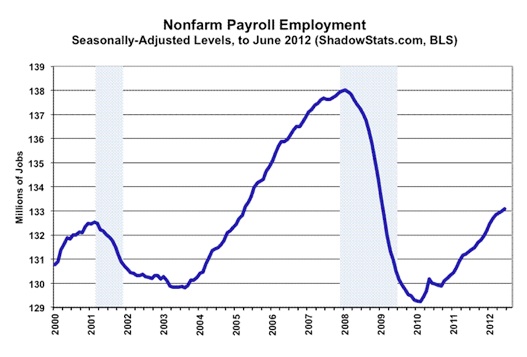 The annual US budget deficit is adding to the accumulated debt at about $1.5 trillion per year with no prospect of declining. The financial system is broken and requires ongoing bailouts. The economy is busted and has been unable to create high-paying jobs, indeed any jobs. Despite years of population growth, payroll employment as of mid-2012 is the same as in 2005 and substantially below 2008. Yet, the government and financial presstitute media tell us that we have a recovery. According to the US Bureau of Labor Statistics, employment in 2011 was only 1 million more than in 2002. As it takes about 150,000 new jobs each month to stay even with population growth, that leaves a decade long job deficit of 15 million jobs. The US unemployment and inflation rates are far higher than reported. In previous columns I have explained, based on statistician John Williams’ work (shadowstats.com), the reasons that the government’s headline numbers are serious understatements. The headline (U3) unemployment rate of 8.2% counts no discouraged workers who have given up on finding a job. The government has a second unemployment rate (U6), seldom reported, which includes short-term discouraged workers. That rate is 15%. When the long-term discouraged workers are added in, the current US unemployment rate is 22%, a number closer to the unemployment rate of the Great Depression than to the unemployment rates of postwar recessions.  Changes in the way inflation is measured have destroyed the Consumer Price Index (CPI) as a measure of the cost of living. The new methodology is substitution based. If the price of an item in the index rises, a lower priced alternative takes its place. In addition, some price rises are labeled quality improvements whether they are or not and thus do not show up in the CPI. People still have to pay the higher price, but it is not counted as inflation. Currently, the substitution-based rate of inflation is about 2%. However, when inflation is measured as the actual cost of living, the rate of inflation is 5%. The Misery Index is the sum of the inflation and unemployment rates. The level of the current Misery Index depends on whether the new rigged measures are used, which understate the misery, or the former methodology that accurately measures it. Prior to the November 1980 election, the Misery Index hit 22%, which was one reason for Reagan’s victory over President Carter. Today if we use previous methodology, the Misery Index stands at 27%. But if we use the new rigged methodology, the Misery Index is 10%. The understatement of inflation serves to boost Gross Domestic Product (GDP). GDP is calculated in current dollars. To be able to determine whether GDP rose because of price rises or because of increases in real output, GDP is deflated by the CPI. The higher the inflation rate, the less the growth in real output and vice versa. When the substitution based methodology is used to measure inflation, the US economy experienced real growth in the 21st century except for the sharp dip during 2008-2010. However, if the cost-of-living based methodology is used, except for a short period during 2004, the US economy has experienced no real growth since 2000 In the chart above,the lower measure (blue) of real GDP is deflated with the inflation methodology that measured cost-of-living. The higher GDP measure (red) deflates GDP with the new substitution based methodology. The lack of employment and real GDP growth go together with the decline in real household median income. The growth in consumer debt substituted for the lack of income growth and kept the economy going until consumers exhausted their ability to take on more debt. With the consumer dead in the water, the outlook for economic recovery is poor. 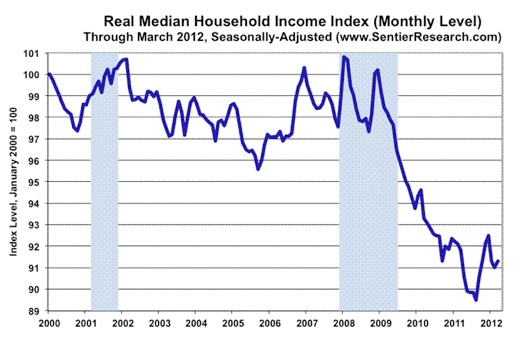 Politicians and the Federal Reserve are making the outlook even worse. At a time of high unemployment and debt-stressed households, politicians at local, state, and federal levels are cutting back on government provision of health care, pensions, food stamps, housing subsidies and every other element of the social safety net. These cutbacks, of course, further reduce aggregate demand and the ability of income-stressed Americans to survive. The Federal Reserve has interest rates so low that retirees and others living on their savings can earn nothing on their money. The interest rates paid on bank CDs and government and corporate bonds are lower than the rate of inflation. To live on interest income, a person has to purchase Greek, Spanish, or Italian bonds and run the risk of capital loss. The Federal Reserve’s policy of negative interest rates forces retirees to spend down their capital in order to live. In other words, the Fed’s policy is destroying personal savings as people are forced to spend their capital in order to cover living expenses. In June the Federal Reserve announced that it was going to continue its policy of driving nominal interest rates even lower, this time focusing on long-term Treasury bonds. The Fed said it would be purchasing $400 billion of the Treasury’s 30-year bonds. Driving interest rates down means driving bond prices up. With 5-year Treasury bonds paying only seven-tenths of one percent and 10-year Treasuries paying only 1.6%, below even the official rate of inflation, Americans desperate for yield move into 30-year bonds currently paying 2.7%. However, the the high bond prices mean that the risk of capital loss is very high. The Fed’s debt monetization, or a drop in the exchange value of the dollar as other countries move away from its use to settle their balance of payments, could set off inflation that would take interest rates out of the Fed’s control. As interest rates rise, bond prices fall. In other words, bonds are now the bubble that real estate, stocks, and derivatives were. When this bubble pops, Americans will take another big hit to their remaining wealth. It makes no sense to invest in long-term bonds at negative interest rates when the federal government is piling up debt that the Federal Reserve is monetizing and when other countries are moving away from the flood of dollars. The potential for a rising rate of inflation is high from debt monetization and from a drop in the dollar’s exchange value. Yet, bond fund portfolio managers have to follow the herd into longer term maturities or see their performance relative to their peers drop to the bottom of the rankings. Some individual investors and foreign central banks, anticipating the dollar’s loss of value, are accumulating gold and silver bullion. Realizing the danger to the dollar and its policy from the rapid rise in the price of bullion during 2011, the Federal Reserve has arranged offsetting action. When the demand for physical bullion drives up the price, short sales of bullion in the paper market are used to drive the price back down. Similarly, when investors begin to flee Treasuries, thus causing interest rates to rise, J.P. Morgan and other dependencies of the Federal Reserve sell interest-rate swaps, thus offsetting the effect on interest rates of the bond sales. (Keep in mind that interest rates rise when bond prices fall and vice versa.) The point of all this information is to establish that except for the 1 percent, the incomes and wealth of Americans are being cut back across the board. From 2002 through 2011 the economy lost 3.5 million manufacturing jobs. These jobs were replaced with lower-paying waitress and bartender jobs (1,189,000), ambulatory health care service jobs (1,512,000) and social assistance jobs (578,000). These replacement jobs in domestic services mean that on a net basis US consumer income was moved out of the country. Potential aggregate demand in the US dropped by the differences in pay in the job categories. Clearly and unambiguously, jobs offshoring lowered US disposable income and US GDP and, thereby, employment. Despite the lack of an economic base, Washington’s hegemonic aspirations continue unabated. Other countries are amused at Washington’s unawareness. Russia, China, India, Brazil, and South Africa are forming an agreement to abandon the US dollar as the currency for international settlement between themselves. On July 4 the China Daily reported: "Japanese politicians and prominent academics from China and Japan urged Tokyo on Tuesday to abandon its outdated foreign policy of leaning on the West and accept China as a key partner as important as the United States. The Tokyo Consensus, a joint statement issued at the end of the Beijing-Tokyo Forum, also called on both countries to expand trade and promote a free-trade agreement for China, Japan and South Korea." This means that Japan is in play. The Chinese government, more intelligent than Washington, is responding to Washington’s military threats by enticing away Washington’s two key Asian allies. As the Chinese economy is now as large as the US and on far firmer footing, and as Japan now has more trade with China than with the US, the enticement is appealing. Moreover, China is next door, and Washington is distant and drowning in its hubris. Washington, which flicked its middle finger to international law and to its own law and Constitution with its arrogance and gratuitous and illegal wars and with its assertion of the right to murder its own citizens and those of its allies, such as Pakistan, has made the United States a pariah state. Washington still controls its bought-and-paid-for NATO puppets, but these puppet states are overwhelmed with derivative debt problems brought to them by Wall Street and by sovereign debt problems, some of which were covered up by Wall Street’s Goldman Sachs. Europe is on the ropes and has no money with which to subsidize Washington’s wars of hegemony. Washington is becoming an isolated and despised element of the world community. Washington has purchased Europe, Canada, Australia, the former Soviet state of Georgia (and almost Ukraine), and Colombia, and continues its effort to purchase the entire world, but sentiment is turning against the rising Gestapo state that has shown itself to be lawless, ruthless, and indifferent, even hostile, to human life and human rights. A government, whose military was unable with the help of the UK to occupy Iraq after eight years and was forced to end the conflict by putting the “insurgents” on the US military payroll and to pay them to stop killing American troops, and a government whose military has been unable to subdue a few thousand lightly armed Taliban after 11 years, is over the top when it organizes war against Iran, Russia, and China. The only prospect Washington has of prevailing in such an undertaking is first use of nuclear weapons, of catching its demonized opponents off guard by nuking them out of the blue. In other words, by the elimination of life on earth. Is this Washington’s program revealed by the neoconservative warmonger, Bill Kristol, who had no shame to ask publicly: “What’s the good of nuclear weapons if you can’t use them?” | |||||
| Paul Craig Roberts is a frequent contributor to Global Research. Global Research Articles by Paul Craig Roberts | |||||
 Email this article to a friend
 Print this article
No comments:
Post a Comment