Tài liệu "FM 3-39.40 Internment and Resettlement Operations" dầy 326 trang (Độc Giả Tải Về Tham Khảo http://info.publicintelligence.net/USArmy-InternmentResettlement.pdf) không chỉ ứng dụng trên nước Mỹ mà được soạn thảo như một "dịch vụ thiết lập trại cải tạo" để bán cho các quốc gia khác trong nguyên tắc "tư hũu hóa" nền an ninh quốc phòng.
Trọng tâm của "món hàng" này là thiết lập một trại tập trung để giam giữ và cải tạo những ai có tư tưởng và hành động đối kháng lại chính sách và chủ trương của Nhà nứoc chính phủ. Theo ký giả Alex Jones, ngừoi chính bản thân trà trộn đươc chọn vào trong nhóm người thực tập chươgn trình này, cho biết là ĐỐI TƯỢNG của kế hoạch tập trung cải tạo này là tất cả những ai chống lại không chỉ là "chính sách" của chính phủ Mỹ mà cả những ai có tư tưởng hành động lên án "văn hóa, lối sống Mỹ", bất kể thuộc Tả khuynh hay Hũu khuynh v.v đều sẽ bị bắt và tập trung. Sau đó trong trại họ sẽ được phân chia quây khu ra tùy vào khuynh hướng chính trị của họ.
Một chương trình nhồi sọ tâm lý sẽ được sử dụng hàng ngày trong mục tiêu "cải tạo quan điểm chính trị văn hóa" của đối tượng. Chẳng hạn như thiết lập các bài đọc rồi mở loa phóng thanh liên tục .
Trang Nhân Chủ đồ đoàn rằng Bộ Quốc phòng Mỹ không phải là tác giả của tập tài liệu hơn 300 trang này, mà đây,
1- Thứ nhất có thể là Mỹ đã ăn cắp bản quyền của Nga hay Trung Quốc rồi ký tên bộ quốc phòng Mỹ.
2- Do chính các công dân Mỹ gốc Ngụy ngục từng là học viên trong các trại "cải tạo" viết lại cho bộ quốc phòng Mỹ.
Vì nếu đọc kỹ nội dung về mục tiêu cũng như "giáo khoa và giáo trình" cho đến phương cách kiến trúc trại v.v Chẳng có gì là khác với trại tù Gulag hay "đại học máu" ở Việt Nam hết cả. Dĩ nhiên những "danh từ chuyên môn" đã được Mỹ hóa và Kỹ thuật máy móc chắc chắn sẽ tân tiến hơn.
Không hiểu lần này Nga và Trung Quốc có biết để kiện bộ quốc phòng Mẽo tại WTO về tội "ăn cắp bản quyền" hay không? Vụ này mà thắng sẽ có thể lên đến bạc tỉ Mỹ kim vì kích thước và tác động sâu xa của "sản phẩm an ninh trật tự" này. Nếu được ứng dụng, chắc chắn thòi kỳ "tôn giáo pháp đình" của giáo hội Công Giáo Trung Cổ cũng không sánh kịp..
NKPTC
Can Americans be Sent to Propaganda Prisons?
Army manual for re-education camps applies to US citizens
By RT
Army manual for re-education camps applies to US citizens
By RT
After reporting this week on a Pentagon-created plan for interning activists at re-education camps, questions were asked about the US Army manual that allegedly outlines the resettling of US citizens. Can Americans be sent to propaganda prisons?
Now as more and more news organizations are investigating the recently unearthed military manual, FM 3-39.40 Internment and Resettlement Operations, verification is coming in that the callous plans to populate military camps in the US and abroad are not only authentic, but indeed establishes blueprints for putting the country’s own citizens into guarded Army detainment centers.
“They always tell the media that it’s for disasters — domestically — or foreign wars and putting people in camps like Abu Ghraib in Iraq or Camp X-Ray in Cuba, but now more and more documents are coming out confirming what I’ve already had from sources and my researching into this,” radio host Alex Jones tells RT. According to Jones, he has seen the Pentagon refit old military bases into camps through the Emergency Centers Establishment Act “to prepare them for, quote, ‘emergencies,’” but there is way more than the government isn’t saying.
“I’ve been to the drills and I noticed that they were training with the role players to put American political dissidents in them,” Jones says about sending US civilians into the camps.
“I witnessed marines training to confiscate firearms on the West Coast and to put Americans both on the left and the right into camps and even segregate them according to their different political persuasions,” adds Jones.
Jones continues that Pentagon officials have informed him in the past about plans to re-educate political activists by armed enforcers, but the leaking of the elusive document confirms what he has been cautioned of in the past.
“Now we have an Army document that dovetails with huge increased spending, hiring tens of thousands of people in the military to specifically be internment camp officers.”
After combing through the 300-plus pages of 3-39.40, the website Infowars also addresses questions over whether or not the manual would make it so that the US government could send its own citizens to reeducation camps. In their own analysis, the site singles out certain sections of the manual that specifically discuss not just “The authority to approve resettlement such operations within US territories,” but how, also, “US citizens will be confined separately from detainees” by being booked and processed according to their Social Security number.
“Last time I checked, the United States Social Security Administration was not responsible for handing out social security numbers to people in Afghanistan or Iraq,” explains Infowar’s Paul Joseph Watson.
As if the text of the paper wasn’t enough, Watson breaks it down for those that are still skeptic that the American military would want to imprison its own citizens and install in them an “appreciation of US policies and actions.”
“The time for denial is over. People spent weeks arguing over the ‘indefinite detention’ provisions of the National Defense Authorization Act, ignoring assertions by top scholars and legal experts that the kidnapping provisions did apply to U.S. citizens,” writes Watson. Sure enough, when US President Barack Obama signed the NDAA into law on December 31, he acknowledged that he had his own reservations about the provisions that provide for the indefinite detention of his own citizens without charge.
Now coupled with a leaked copy of the Internment and Resettlement Operations guide, it looks as if not only can the US imprison its own citizens that disagree with the government — but it has already laid out the rules.
“This isn’t just some contingency plan,” Alex Jones tells RT. “This is the manual.”
--------------Restricted U.S. Army Internment and Resettlement Operations Manual
May 2, 2012 in U.S. Army

FM 3-39.40 Internment and Resettlement Operations
- 326 pages
- Distribution authorized to the DOD and DOD contractors only to protect technical or operational information from automatic dissemination under the International Exchange Program or by other means.
- February 12, 2010
- 3.59 MB

I/R operations facilitate the ability to conduct rapid and decisive combat operations; deter, mitigate, and defeat threats to populations that may result in conflict; reverse conditions of human suffering; and build the capacity of a foreign government to effectively care for and govern its population. This includes capabilities to conduct shaping operations across the spectrum of military operations to mitigate and defeat the underlying conditions for conflict and counter the core motivations that result in support to criminal, terrorist, insurgent, and other destabilizing groups. I/R operations also include the daily incarceration of U.S. military prisoners at facilities throughout the world.
This manual continues the evolution of the I/R function to support the changing nature of OEs. In light of persistent armed conflict and social turmoil throughout the world, the effects on populations remain a compelling issue. The world population will increase from 6 billion to 9 billion in the next two decades, with 95 percent of the growth occurring in the developing world. By 2030, 60 percent of the world’s population will live in urban areas. Coexisting demographically and ethnically, diverse societies will aggressively compete for limited resources.
Typically, overpopulated third world societies suffer from a lack of legitimate and effective enforcement mechanisms, which is generally accepted as one of the cornerstones of a stable society. Stability within a population may eliminate the need for direct military intervention. The goal of military police conducting detainee operations is to provide stability within the population, its institutions, and its infrastructure. In this rapidly changing and dynamic strategic environment, U.S. forces will compete with local populations for the same space, routes, and resources. The modular force’s ability to positively influence and shape the opinions, attitudes, and behaviors of select populations is critical to tactical, operational, and strategic success.
An adaptive enemy will manipulate populations that are hostile to U.S. intent by instigating mass civil disobedience, directing criminal activity, masking their operations in urban and other complex terrain,
maintaining an indistinguishable presence through cultural anonymity, and actively seeking the traditional sanctuary of protected areas as defined by the rules of land warfare. Such actions will facilitate the dispersal of threat forces, negate technological overmatches, and degrade targeting opportunities. Commanders will use technology and conduct police intelligence operations to influence and control populations, evacuate detainees and, conclusively, transition rehabilitative and reconciliation operations to other functional agencies. The combat identification of friend, foe, or neutral is used to differentiate combatants from noncombatants and friendly forces from threat forces.
…
Civilian Internees
1-10. A CI is a civilian who is interned during armed conflict, occupation, or other military operation for security reasons, for protection, or because he or she committed an offense against the detaining power. (JP 3-63) CIs, unless they have committed acts for which they are considered unlawful combatants, generally qualify for protected status according to the GC, which also establishes procedures that must be observedwhen depriving such civilians of their liberty. CIs are to be accommodated separately from EPWs and persons deprived of liberty for any other reason.
1-11. Protected persons are persons protected by the Geneva Convention who find themselves, in case of a conflict or occupation, in the hands of a party to the conflict or occupying power of which they are not nationals. (AR 190-8). Protected persons who are interned for imperative reasons of security are also known as CIs. Protected persons under the Geneva Conventions include—Note. If protected persons are detained as spies or saboteurs or are suspected of or engaged in activities hostile to the security of the state or occupying power, they may be interned or imprisoned. In such cases, they retain their status as a protected person and are granted the full rights and privileges of protected persons.
- Hors de combat (refers to the prohibition of attacking enemy personnel who are “out of combat”).
- Detainees (combatants and CIs).
- Wounded and sick in the field and at sea.
- Civilians.
…
DISLOCATED CIVILIANS
1-19. The term dislocated civilian is a broad term that includes a displaced person, an evacuee, an expellee, an internally displaced person, a migrant, a refugee, or a stateless person. (JP 3-57) DCs are individuals who leave their homes for various reasons, such as an armed conflict or a natural disaster, and whose movement and physical presence can hinder military operations. They most likely require some degree of aid, such as medicine, food, shelter, or clothing. DCs may not be native to the area or to the country in which they reside. (See chapter 10.) The following DC subcategories are also defined in JP 3-57:…
- Displaced person. A displaced person is a civilian who is involuntarily outside the national boundaries of his or her country. (JP 1-02) Displaced persons may have been dislocated because of a political, geographical, environmental, or threat situation.
- Evacuee. An evacuee is a civilian removed from a place of residence by military direction for reasons of personal security or the requirements of the military situation. (JP 3-57)
- Internally displaced person. An internally displaced person is any person who has left their residence by reason of real or imagined danger but has not left the territory of their own country.Internally displaced persons may have been forced to flee their homes for the same reasons as refugees, but have not crossed an internationally recognized border.
- Expellee. An expellee is a civilian outside the boundaries of the country of his or her nationality or ethnic origin who is being forcibly repatriated to that country or to a third country for political or other purposes. (JP 3-57)
- Migrant. A migrant is a person who (1) belongs to a normally migratory culture who may cross national boundaries, or (2) has fled his or her native country for economic reasons rather than fear of political or ethnic persecution. (JP 3-57)
- Refugee. A refugee is a person, who by reason of real or imagined danger, has left their home country or country of their nationality and is unwilling or unable to return.
- Stateless person. A stateless person is a civilian who has been denationalized or whose country of origin cannot be determined or who cannot establish a right to the nationality claimed.
AGENCIES CONCERNED WITH INTERNMENT AND RESETTLEMENT
1-40. External involvement in I/R missions is a fact of life for military police organizations. Some government and government-sponsored entities that may be involved in I/R missions include—1-41. The U.S. Army National Detainee Reporting Center (NDRC), supported by theater detainee reporting centers (TDRCs), detainee accountability, including reporting to the ICRC central tracing agency.
- International agencies.
- UN.
- International Committee of the Red Cross (ICRC).
- International Organization of Migration.
- U.S. agencies.
- Local U.S. embassy.
- Department of Homeland Security.
- U.S. Immigration and Customs Enforcement (ICE).
- Federal Emergency Management Agency.
1-42. There are also numerous private relief organizations, foreign and domestic, that will likely be involved in the humanitarian aspects of I/R operations. Likewise, the news media normally provides extensive coverage of I/R operations. Adding to the complexity of these operations is the fact that DOD is often not the lead agency. For instance, the DOD could be tasked in a supporting role, with the Department of State or some other agency in the lead. (See appendix E.)
…
SUPPORT TO CIVIL SUPPORT OPERATIONS
2-39. Civil support is the DOD support to U.S. civil authorities for domestic emergencies, and for designated law enforcement and other activities. (JP 3-28) Civil support includes operations that address the consequences of natural or man-made disasters, accidents, terrorist attacks and incidents in the U.S. and its territories.
2-40. The I/R tasks performed in support of civil support operations are similar to those during combat operations, but the techniques and procedures are modified based on the special OE associated with operating within U.S. territory and according to the categories of individuals (primarily DCs) to be housed in I/R facilities. During long-term I/R operations, state and federal agencies will operate within and around I/R facilities within the scope of their capabilities and identified role. Military police commanders must closely coordinate and synchronize their efforts with them especially in cases where civil authority and capabilities have broken down or been destroyed.
…
PSYCHOLOGICAL OPERATIONS OFFICER
3-55. The PSYOP officer in charge of supporting I/R operations serves as the special staff officer responsible for PSYOP. The PSYOP officer advises the military police commander on the psychological impact of military police or MI actions to prevent misunderstandings and disturbances by detainees and DCs. The supporting I/R PSYOP team has two missions that reduce the need to divert military police assets to maintain security in the I/R facility. (See appendix J.) The team—3-56. The PSYOP team also supports the military police custodial mission in the I/R facility. The team—
- Assists the military police force in controlling detainees and DCs.
- Introduces detainees or DCs to U.S. and multinational policy.
…
- Develops PSYOP products that are designed to pacify and acclimate detainees or DCs to accept U.S. I/R facility authority and regulations.
- Gains the cooperation of detainees or DCs to reduce the number of guards needed.
- Identifies malcontents, trained agitators, and political leaders within the facility who may try to organize resistance or create disturbances.
- Develops and executes indoctrination programs to reduce or remove antagonistic attitudes.
- Identifies political activists.
- Provides loudspeaker support (such as administrative announcements and facility instructions when necessary).
- Helps the military police commander control detainee and DC populations during emergencies.
- Plans and executes a PSYOP program that produces an understanding and appreciation of U.S. policies and actions.
DETAINEE PROCESSING TECHNIQUE
4-33. Upon capture, Soldiers must process detainees using the “search, silence, segregate, speed, safeguard, and tag (5 Ss and T)” technique. This technique provides a structure to guide Soldiers in conducting detainee operations until they transfer custody of detainees to another authority or location. Complete the “5 Ss and T” technique as follows:…
- Search. Neutralize a detainee and confiscate weapons, personal items, and items of potential intelligence and/or evidentiary value.
- Silence. Prevent detainees from communicating with one another or making audible clamor such as chanting, singing, or praying. Silence uncooperative detainees by muffling them with a soft, clean cloth tied around their mouths and fastened at the backs of their heads. Do not use duct tape or other adhesives, place a cloth or either objects inside the mouth, or apply physical force to silence detainees.
- Segregate. Segregate detainees according to policy and SOPs (segregation requirements differ from operation to operation). The ability to segregate detainees may be limited by the availability of manpower and resources at the POC. At a minimum, try to segregate detainees by grade, gender, age (keeping adults from juveniles and small children with mothers), and security risk. MI and military police personnel can provide additional guidance and support in determining the appropriate segregation criteria.
- Speed. Quickly move detainees from the continuing risks associated with other combatants or sympathizers who may still be in the area of capture. If there are more detainees than the Soldiers can control, call for additional support, search the detainees, and hold them in place until reinforcements arrive.
- Safeguard. Protect detainees and ensure the custody and integrity of all confiscated items. Soldiers must safeguard detainees from combat risk, harm caused by other detainees, and improper treatment or care. Report all injuries. Correct and report violations of U.S. military policy that occur while safeguarding detainees. Acts and/or omissions that constitute inhumane treatment are violations of the law of war and, as such, must be corrected immediately. Simply reporting violations is insufficient. If a violation is ongoing, a Soldier has an obligation to stop the violation and report it.
- Tag. Ensure that each detainee is tagged using DD Form 2745. Confiscated equipment, personal items, and evidence will be linked to the detainee using the DD Form 2745 number. When a DA Form 4137 is used to document confiscated items, it will be linked to the detainee by annotating the DD Form 2745 control number on the form.
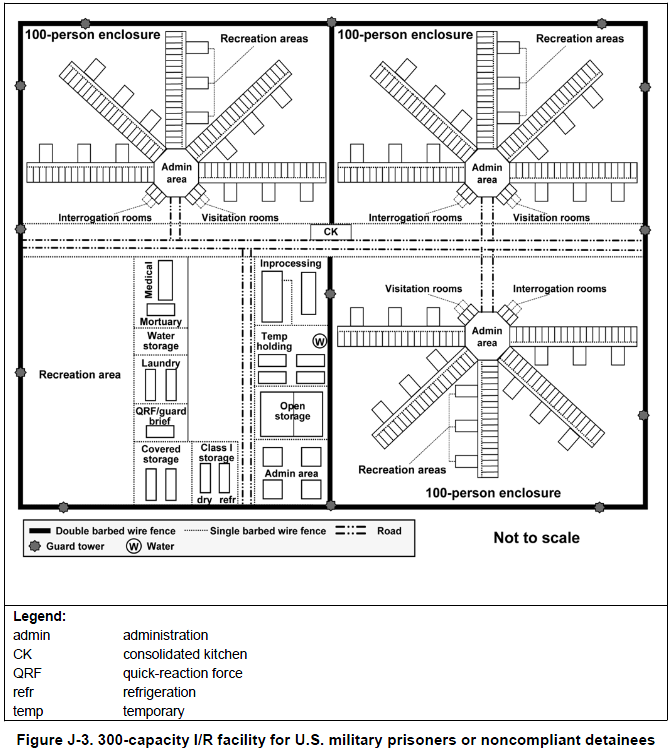
6-8. When constructing a facility, planning considerations may include, but are not limited to—6-9. The facility layout depends on the nature of the operation, terrain, building materials, and HN support. Each facility should contain—
- Clear zones. As appropriate, mission variables determine the clear zone surrounding each facility that houses detainees. Construct at least two fences (interior and exterior) around the detainee facility and ensure that the clear zone between the interior and exterior fences is free of vegetation and shrubbery.
- Guard towers. Locate guard towers on the perimeter of each facility. Place them immediately outside the wall or, in case of double fencing, where they permit an unobstructed view of the lane between the fences. The space between towers must allow overlapping observation and fields of fire. During adverse weather, it may be necessary to augment security by placing fixed guard posts between towers on the outside of the fence. Towers must be high enough to allow an unobstructed view of the compound and low enough to permit an adequate field of fire. The tower platform should have retractable ladders and should be wide enough to mount crew-served weapons. Another consideration involves using nonlethal capabilities from guard towers.
- Lights. Provide adequate lighting, especially around compound perimeters. Illuminating walls and fences discourages escapes, and illuminating inner strategic points expedites the handling of problems caused by detainees. Lights should be protected from breakage with an unbreakable glass shield or a wire mesh screen. Ensure that lights on the walls and fences do not interfere with the guards’ vision. Provide secondary emergency lighting.
- Patrol roads. Construct patrol roads for vehicle and foot patrols. They should be adjacent to outside perimeter fences or walls.
- Sally ports. A sally port is required to search vehicles and personnel entering and leaving the main compound. It is recommended that a sally port be placed at the back entrance to the facility.
- Communications. Ensure that communication between the towers and the operation headquarters is reliable. Telephones are the preferred method; however, ensure that alternate forms of communication (radio and visual or sound signals) are available if telephones are inoperable.
…
- Barracks (may be general-purpose medium tents in the early stages of an operation).
- Kitchen and dining facilities.
- Bath houses.
- Latrines.
- Recreation areas.
- Chapel facilities.
- Administrative areas with a command post, an administrative building, an interrogation facility, a dispensary, an infirmary, a mortuary, and a supply building.
- Receiving and processing centers.
- Maximum security areas with individual cells.
- Parking areas.
- Trash collection points.
- Potable water points.
- Storage areas.
- Hazardous materials storage areas.
- Generator and fuel areas.
Related posts:
- U.S. Military Police Internment/Resettlement Operations Manual
- National Guard Looking for Internment/Resettlement Specialists
- Restricted U.S. Army Special Operations Forces (ARSOF) Religious Factors Analysis Manual
- Internment/Resettlement Specialist (31E)
- U.S. Army Counterguerrilla Operations Manual
- Restricted U.S. Military Multi-Service Civil Support Operations Manual
- (U//FOUO) U.S. Army Intelligence Support to Urban Operations Field Manual
- U.S. Army FM 3-19.15 Civil Disturbance Operations
No comments:
Post a Comment